Home / Real-time bidding for calls
Real-time bidding for calls, with a reason for every answer
01 · The idea
What RTB for calls means
A caller is on the line with a publisher. Before the publisher sends that call anywhere, they ask the campaign a question: will you take this caller, and what will you pay?
That question is the ping. The answer is the bid. Because the caller is waiting, the answer has to come back right away, and it has to be backed by a real buyer who is free to pick up.
02 · Beside fixed pricing
RTB or a fixed number
With a fixed number, the publisher sends the call and learns later whether it paid. If no buyer was free, the call is wasted and the caller has a bad experience.
With RTB, nothing is sent until a buyer is held. The publisher sees the payout before the call moves, and a no-bid tells them to try somewhere else while the caller is still on the line. InboundX also routes calls to dedicated numbers through the same checks, so both kinds of traffic follow one set of rules.
03 · Step by step
How a bid happens on InboundX
1. The publisher sends one ping with their key. The key names one campaign offer, so they never pick from a list.
2. InboundX checks the lead, the coverage, and every buyer on the campaign.
3. The buyer who has been idle longest is held. The bid comes back with the payout and an address to send the call to.
4. The publisher sends the call before the hold runs out. It rings the held buyer in their browser.
5. The call is billed when it qualifies, and the publisher gets a conversion postback with the call ID and payout. The full path is on how it works.
04 · The answer
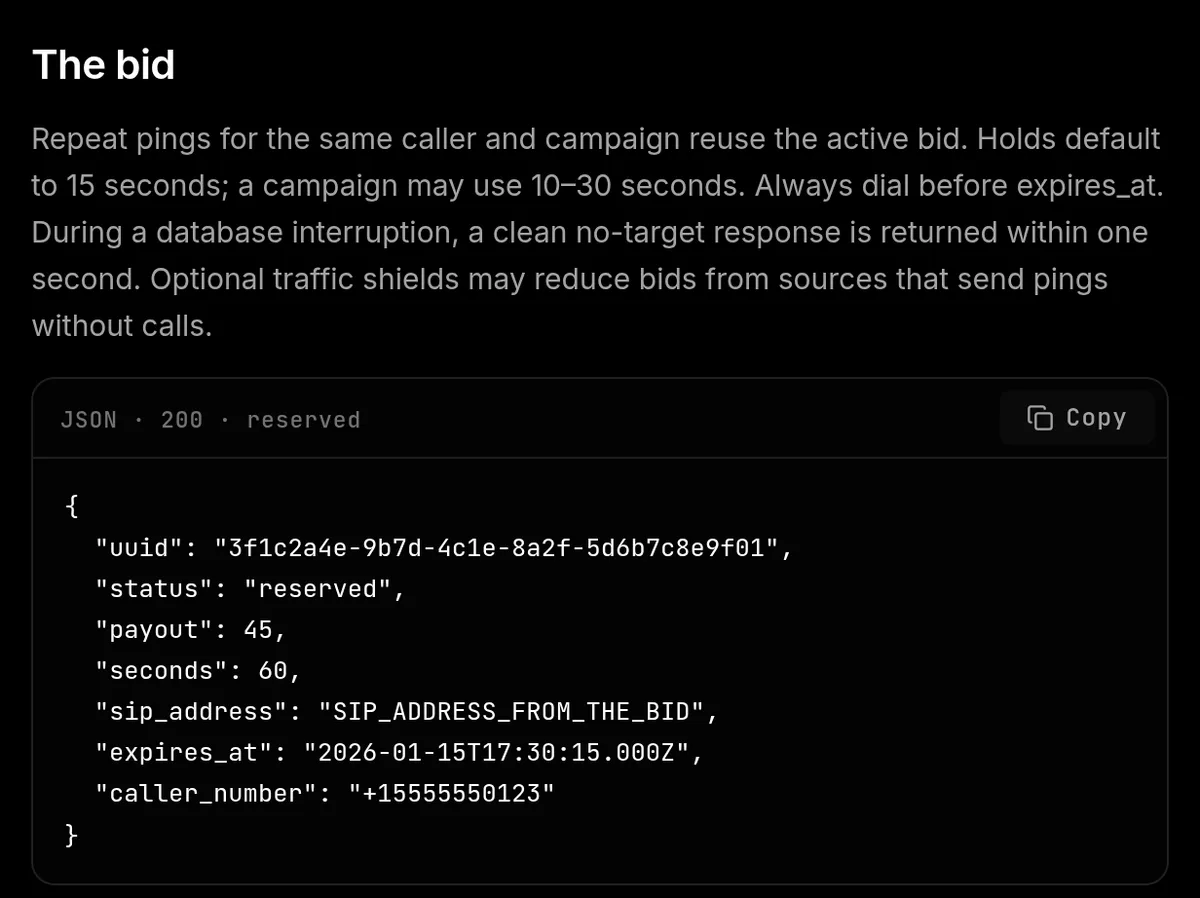
What a bid tells the publisher
- status: reserved, so the publisher knows a buyer is held
- payout: what a qualified call pays, in US dollars
- seconds: how long the call must last to pay, on a duration campaign
- an address to send the call to
- expires_at: when the hold runs out
- caller_number: the caller the bid was made for
The hold lasts 15 seconds by default, and a campaign can set it between 10 and 30. A second ping from the same publisher for the same caller and campaign gets the same bid back, so a retry never holds two buyers.
05 · Before a yes
What is checked before a bid
- The ping key names one campaign offer
- The lead carries every field the offer asks for
- The caller's state or zip is covered
- At least one buyer is online, inside working hours
- That buyer takes the state and has a funded wallet
- That buyer is approved, not paused, and selected this campaign
A call that arrives without an active hold is refused before anyone answers. Routing rules in more detail are on the call routing platform page.
06 · The no
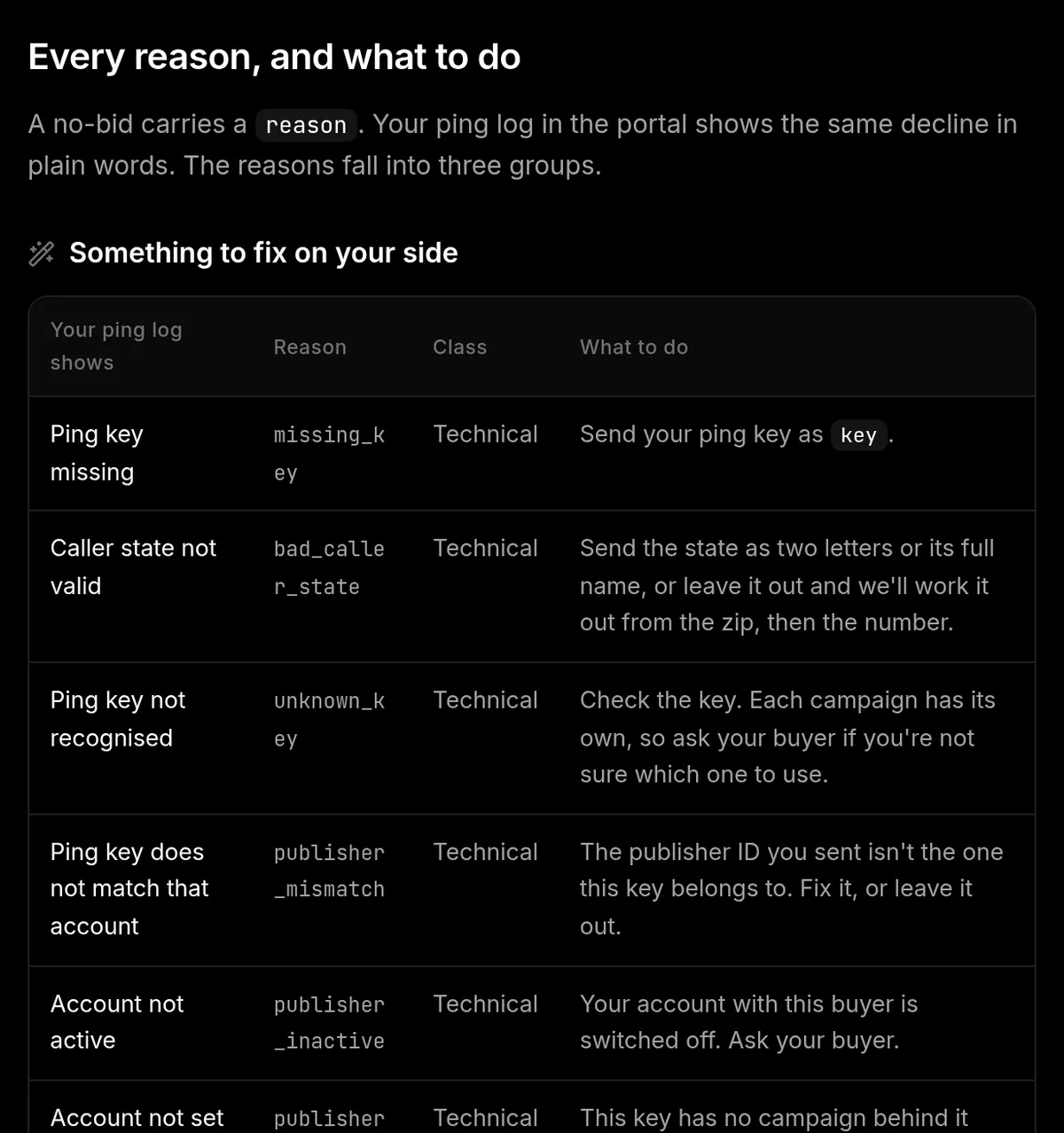
Every no-bid comes with a reason
A no-bid is not a dead end. It says what went wrong, such as no buyer online, a state that is not covered, or a lead field that is missing. The publisher’s ping log shows the same reason in plain words.
Publishers can also dry-run a ping before sending real traffic, to see the answer without holding anyone.
07 · Who it serves
Publishers, buyers, and the network
Publishers get a fast answer and a reason when it is no. Buyers only ring when they are free, and only for campaigns they selected. You, the network, set the payout and the coverage, and every ping is kept with its answer.
To run this under your own brand, see white-label pay-per-call. Publishers can read the publisher docs today, and see what pay-per-call publishers get in one place.
08 · Questions
Asked about RTB for calls
- 01What is real-time bidding for calls?
- Real-time bidding for calls (RTB) is how a publisher finds out, while the caller waits, whether a campaign will take a call and what it pays. On InboundX the publisher sends one ping, InboundX checks every buyer on the campaign and holds one, and the answer comes back as a bid with a payout and a place to send the call, or a no-bid with the reason.
- 02How is RTB different from a fixed price per call?
- With a fixed price, the publisher sends a call to a number and finds out later whether it paid. With RTB the publisher asks first, while the caller waits, and gets a yes with a payout or a no with a reason. On InboundX the payout is set on the campaign offer, so a bid tells the publisher exactly what a qualified call will pay.
- 03How long does a bid hold a buyer?
- 15 seconds by default. A campaign can set its own hold between 10 and 30 seconds. If the same publisher pings again for the same caller and campaign while the hold is active, it gets the same bid back instead of a second buyer being held.
- 04What happens when there is no bid?
- The answer says why: no buyer online, outside hours, state not covered, a missing lead field, and so on. The publisher's ping log shows the same reason in plain words, so they can fix their side without asking you.
- 05Can a publisher test before sending real calls?
- Yes. A publisher can dry-run a ping to see what the answer would be, without holding a buyer. Every real ping is kept with its answer and reason.
- 06What stops a call from arriving without a bid?
- A call that arrives without an active hold is refused before anyone answers. The hold is the permission to send the call.
- 07Do buyers need special phones to take RTB calls?
- No. Buyers answer in a browser tab after a short device check. There is no desk phone and nothing to install.
09 · Next
Take bids under your brand
Open a workspace and set up a campaign offer, or read how the rest of the call works first.